
Welcome to the Unlocking behaviour Change Podcast: Episode 1
Jamie and Robert West discuss psychology and behaviour. The first series of episodes is about 'real world' decision-making.

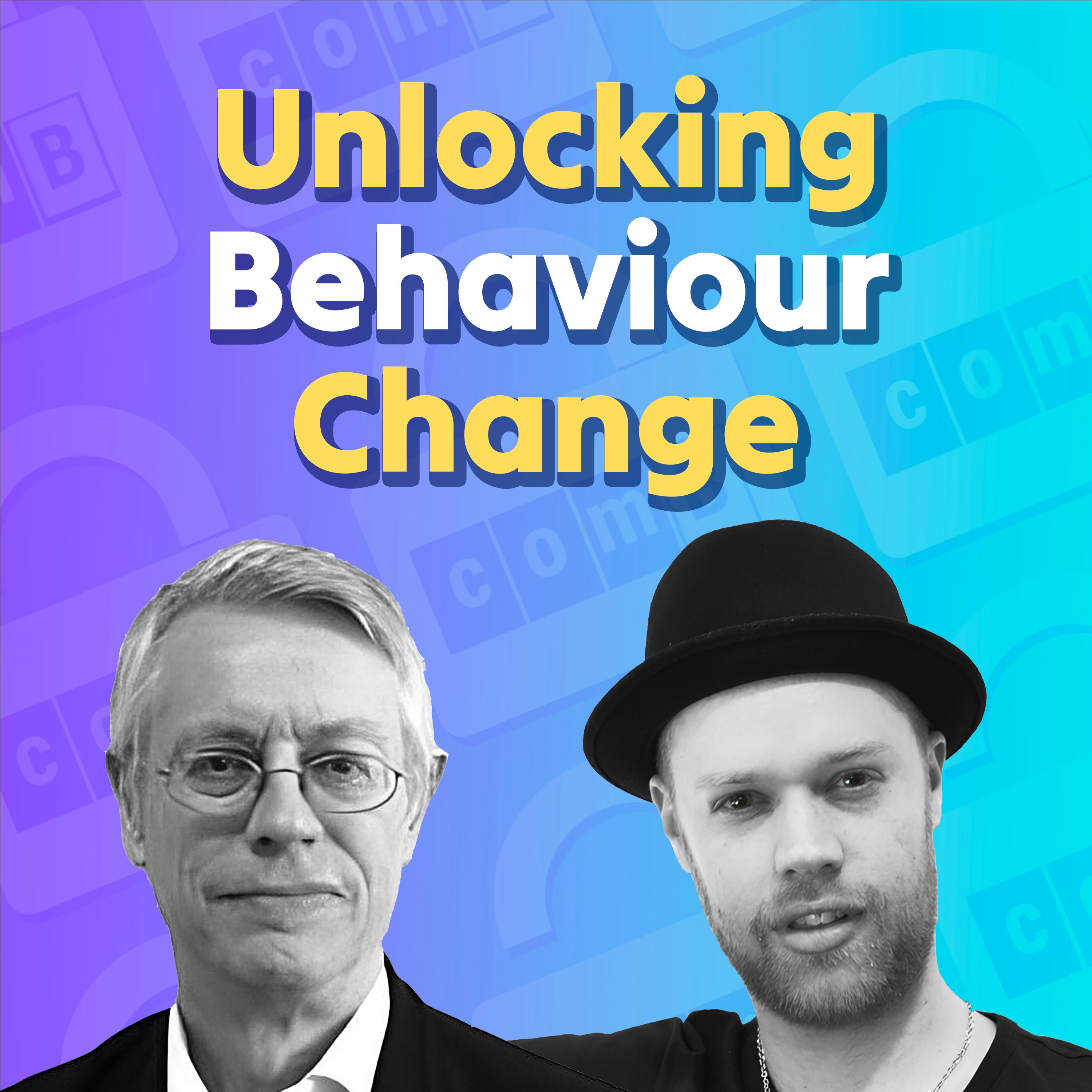
JAMIE WEST
Hello and welcome to the Unlocking Behaviour Change podcast with your host, me, Jamie West. And me, Robert West. Robert West, that's who you are. I've seen you around. So this is a podcast all about psychology and how to change behaviour. And Robert, you are Professor Emeritus at UCL.
ROBERT WEST
I'm Professor Emeritus, which stands for retired but still working. And I feel I should know this, but you are Professor of Psychology? Professor of Health Psychology at UCL, working primarily in the field of behavior change as it relates to health and sustainability.
JAMIE WEST
Oh, that sounds rehearsed. Do you have to say that often? … And I am Jamie West. We have written a few books together. We first wrote The Smoke-Free Formula back in 20-something like that. And that was published by Orion in the UK and lots of different publishers around the world. And then we more recently did some books that are more like a dialogue between us, which were Energize: The Secrets of Motivation and React: Harness Your Animal Brain.
ROBERT WEST
Yes, and we have a book that will be coming out eventually. It's been sitting with me after Jamie's done a lot of work on it for now, few years. I think it was going to be published pretty much when I retired five years ago. But fortunately, lots and lots of stuff has happened that can go into the book. It's called 'Reflect', the Science of Real World Decision Making. And this is really an accompaniment to these other two books. So Energize is very much about the motivational system and what makes us do things in the round. React is very much about our emotions, our drives, our habits, and how we can address those and exercise self-control. And then Reflect is very much about bringing to a general audience, but also I guess it should be of interest to people who specialize in decision-making, what we know about the science of decision-making. With a big twist which is as applied to real-world settings and the issue there is that there's lots of terrific research being done into judgment and decision making but a lot of it is in quite artificial laboratory-type situations and simulations of decisions and In the real world, things often tend to be different and you would probably come to different conclusions often about how people make decisions and how you can improve them.
JAMIE WEST
And for people who are just joining us, this could be a podcast for them. Maybe they're thinking, I need a new podcast. I personally am looking for a podcast at the moment. Maybe this could be my podcast. Why should people listen to us?
ROBERT WEST
Fun and education, the usual two things. I think that, I guess, I have been working in the field of behavioral science and behavior change, and been studying all these topics for several decades, and I hope have some interesting insights to help people both in their professional and personal lives. To help people to understand the science behind human behavior a bit better. And of course, you are?
JAMIE WEST
I am a writer, musician, performer, and I also have a degree from UCL, this time in English literature. And then I went on to do a creative writing master's at Birkbeck. The books, I think, are fun because they've got jokes in them. And most psychology books really don't have any jokes. A few do. I think sometimes, maybe we'll come on to this, there's something when you're talking about psychology, psychologists; they can get quite focused on very small studies or it can get quite technical. And that's important, but we need to bridge the gap. So I'm sort of the bridge. What do you think of that? Pretty good, hey?
ROBERT WEST
I think so. I think it's a good combination. Because I can get quite technical sometimes, and I don't mind being technical, but then you can say, well, hang on a minute, what on earth are you going on about? What are you talking about? So we'll see how it goes, but I'm very optimistic that however many listeners there might be, those that do listen and stick with it will get something out of it.
JAMIE WEST
Yeah, I definitely think so. So let's go back to when you first became interested in decision making, which is what we'll be talking about for this first sort of season of the podcast. You've been looking at decision making and interested in it for a long time.
ROBERT WEST
I started getting interested in decision making in 1970. When I was working in the Ministry of Defence in the office of the First Sea Lord, which is the Chief of the Navy.
JAMIE WEST
Sea Lord?
ROBERT WEST
Sea Lord, I know. Very, very sort of harking back to Nelson. I think they still call him or her, could be at some point, the First Sea Lord. I suppose they'd have to be the First Sea Lady. If it became a woman. But so the boss of the Navy and I was involved in a number of kind of areas in a team called Naval Plans. My boss at that time was a guy called Sandy Woodward, who then went on to lead the task force in the Falklands War. He was a captain at that time, but then became an admiral. And one of the things that we had to do in this was to look at naval strategy and also the design of the next generation of naval ships. And I noticed, coming from a psychology background, that the decision-making process had some very interesting features to it. On the one hand, and I'm sure this will resonate with people who work in jobs where there's a lot of technical decision making to engage in. On the one hand, huge professionalism, huge amounts of experience, systems for making decisions. Because, you know, you decide to design a new ship, there's a lot at stake. You know, it's going to cost a hell of a lot of money. It's going to be, you know, a decade or more before the ship comes into being. And if you've got it wrong, then that's, you know, obviously a serious matter. So there's a lot of expertise, technical help, technical support that goes into the decision making. On the other hand, there's also a lot of subjectivity. And of course, in most difficult real-world decisions, there's obviously going to be uncertainty. You don't know what the situation is going to be like in 10 years by the time this ship is built. And the technology will have moved on. The potential threat, if it's something to do with the armed forces, may well have changed and moved on. Potential adversaries will be developing their things. So you're dealing with a moving target and you're trying to predict a situation that will be happening in possibly over 10 years'time. And of course, that is also true in many business decisions. It's true in a lot of academic decisions as well. And so with that kind of situation, apart from the sort of technical side where you're working things out and trying to find the right answer to questions, there's a lot of subjectivity. In that subjectivity, what I noticed was that people's preferences, desires, personality, emotions, and so on were also playing a very crucial role. And that then led me to want to come back to UCL to do a PhD in decision-making, which I got funding to do. But when I started doing the work, I realized that I was going to have to create new measures of people's attitudes, which obviously goes a lot into decision making, because the ones that were there at that time weren't really up to the job. They had a lot of issues with them. And so my PhD ended up being about attitude measurement instead of decision making. I carried on with my interest in decision making for the next few decades. And finally, finally, now that I've retired, I can put it all together into a book and obviously take advantage of the huge advances that have been made in the science of decision making since then.
JAMIE WEST
Yeah, and we've been developing a framework that we will be going into in much detail. Because you wanted something for decision-making that was a bit like, some of our listeners will know, the Combee theory, which you developed, I think, with Susan Mickey? Yeah, we developed it jointly, yeah. And you wanted, it's not quite the same thing, but something that could help people break down how we might think about decisions and the different aspects of decision making. And we may as well do the big reveal now, which is that it's called Facet Theory, F-A-C-E-T. And we will be going through that as well. I guess we'll do a brief introduction of what that is. But just the idea that we might need a framework for decision making, it's so messy, isn't it? Yeah, that's the thing.
ROBERT WEST
In a way, you might argue, how can you possibly have a model of decision-making given that there's so many different ways in which people make decisions, there's so much different stuff going on in decisions, that having a single framework for decision-making sounds rather ambitious. We could talk about this more maybe in another episode, but frameworks have been developed. There's classically the subjective expected utility model, which is primarily used in economics, which is a very general framework. But, but, but, but. It only captures a certain kind of decision making in a certain kind of scenario. And it does it in a way that I think everyone now who works in the field recognizes is not just an oversimplification, but it is simply wrong. It has some features that are important about the way that we evaluate different options and decisions. And in other ways, it is just plain wrong and would take you down a wrong path in terms of making predictions. But that was intended when it was first created as a general model. You have other kinds of-Hang on a second.
JAMIE WEST
That was subjective expected. These have great names, very catchy names. Subjective Expected Utility theory, S-E-U theory. Subjective Expected Utility theory. Yeah. And just very briefly, what is it and why is it so terribly wrong?
ROBERT WEST
Well, long story short, it says that we make decisions by looking at the different options and for each option, we look at the possible consequences of that option. For each of those possible consequences, we say, well, how likely is it to occur? And then for each of those options, we say, well, how much do we like it or dislike it? What's the utility? As the technical term is for us, if it were to occur. So to take a simple example, when you're deciding whether or not to buy a lottery ticket, the probability of losing one quid or two quid or five quid or how much the ticket is, is one, because you're definitely going to spend that money. The utility, the negative utility for it is small because it's only a small amount of money. On the other hand, for the other option, which is buying the, well, for the option, sorry, on the other hand, if you buy the ticket, there is a probability, a likelihood, which is extremely small, of winning a prize, but the utility of that prize is extremely large. So what you've got is the certainty of giving away five quid or whatever with a very remote possibility of winning a million quid. And when people make decisions, they're weighing up these kinds of different probabilities and utilities. It is used in economics, this approach, or a variant of it is used, which recognises that there are some quirks to the way that we go about this process, like, for example, tending to value or to place more importance on negative outcomes than positive outcomes. Things like the fact that the difference between a million quid and 1. 1 million quid, which is £100,000, is less significant than the difference between 50,000 and 150,000. So, in the context of a large amount, a given amount is judged as less important. There's a lot of quirks like that. But the problem is that a lot of our decisions don't involve that kind of future orientation. They don't involve us looking into the future and assessing probabilities. We follow rules. We look at patterns. So, for example, when a GP is deciding what to do when presented with a patient with a set of symptoms, the GP will very often engage in more of a sort of pattern matching. Type approach where they'll say, well, if the patient's got a sore throat, they've had it for this amount of time. I look at the throat and it's got evidence of bacterial infection there. And it's a Friday evening. So I don't want the patient contacting us over the weekend. I will prescribe antibiotics, let's say. So in that situation, the GP is not looking you know what the probabilities and utilities are of the different courses of action, but they're matching the situation to a pattern. Similar sort of thing when a pilot is flying an aircraft and an engine fire warning comes on, they follow the engine fire warning checklist, which may be a memory item checklist that in their training they've recalled or they go to a checklist on the screen or in their manual. So again, they're using pattern matching. So these two Very different modes of decision-making can result in very different outcomes. And what we see in the judgment and decision-making literature is that they haven't been pulled together into a single model terribly well, or in fact, mostly at all. So what I wanted to do was to say, okay, these are very different models and there are others. Let's pull them together into a single framework and then we can make a decision about how we can predict which path a person is going to go down.
JAMIE WEST
So this is a case of synthesizing a lot of research that has already been done, a lot of it's already been done, but they're just sort of in separate fields. And we need ways to think about how people really act in the real world. Because sometimes the way that psychology experiments are done, they're often done on computers with students from the university and they might be paid a five or 20 quid or something to take part. I think I did some of them when I was at university because you'd go in for a couple of hours and click on. You know, they'd have some sort of strange computer program that you'd click through. And sometimes you would think, gosh, is this applicable? People getting paid to do this. I wasn't concerned about being paid to do it. It was more that sometimes you sort of think it can seem very abstract.
ROBERT WEST
Yeah, yeah. That's the thing. Yeah, exactly that. These decisions are taken out of context. I mean, another important feature of real-world decision making is that almost no decisions take place in isolation as they do in a lot of these laboratory experiments. They come in clusters and they have consequences for other decisions. And the context of those decisions is incredibly important in determining what decisions are made. So that's another, as you say, that's another feature. For ethical reasons, largely, and possibly cost and practical reasons, in laboratory decision-making tasks, they've really got to be decisions that don't matter that much. Because you don't really want to be putting people through stressful, conflicting-type decisions that really matter to them. In a laboratory experiment where if they make the wrong decision, it's going to have terrible consequences for them. But of course, in real-world decisions that we mostly care about, that's why we care about them, because they really, really do matter. And so studying and getting a better understanding of what happens when you have these real-life, real-world decisions that matter is incredibly important, but also very difficult to do in the laboratory.
JAMIE WEST
And there's a huge emotional component; everybody knows that depending on the emotion you're experiencing, your decisions are very different when you're very frightened, you make a different decision as to when you're feeling bold, courageous or carefree.
ROBERT WEST
Yeah, absolutely. And to be fair, this has been captured in another framework. So, you know, I've talked about subjective expected utility theory, which is future-oriented, very sort of analytical type theory. I've talked about pattern matching, but also Janice and Mann, a couple of terrific, absolutely brilliant psychologists wrote a book called Decision Making, which focused-Good title, it's a good title, which focused on this precisely what you're talking about, what happens under situations of different stress constraints, but also what happens when you've got decisions where, for example, there is no good option. What happens when As can often happen, it's a Hobson's choice, as they would say. It's just two bad options, and one of them is worse than the other. And so what I also have tried to do, what we're doing in the book, is to bring that side of things, the emotion, the role of stress, time pressure, and Hobson's choices into the picture.
JAMIE WEST
And that's very fascinating, isn't it? The idea that you've got two bad options, but they may not be equally bad. And yet, the way our brains work is we go ‘ah, they're all the same. What does it matter?’ And, actually, as people in the United States, some of them may be discovering it really does matter massively, you know. The detail and the nuance can have vital consequences for you, and you may just want to take the least bad option, but we don't like to take a bad option.
ROBERT WEST
It's tough, I mean as someone who, you know, has feelings very strongly about political issues because they affect human welfare, animal welfare, and the planet's welfare. When you're faced with what is effectively, in our country, the UK, a two-party system where you feel that both of them, both of the parties are unacceptable in value terms, it's very tough to vote. For a party that you believe is unacceptable, but you're pretty confident is not as bad as the other one. And of course, what then happens and what we see in politics is a disengagement, is that people say, well, I won't vote. But deciding not to vote is a decision. And that's another thing, Janice and Mann in their book cover this quite well, is this idea that if you think you're disengaging, that reduces your cognitive dissonance, your sort of feeling of threat because of having to make a decision between two bad options. You say, well, I won't make a decision, but that's a decision. And you end up with more than a third of people who could vote not voting and suffering the consequences of the fact that the worst of the options that was actually on the table ends up being put into place. So another aspect of real-world decision-making that we will be covering is the idea that deciding to decide is a decision and has consequences. And there is no such thing, literally no such thing as abdicating from a decision. It may feel like you are, but you're not.
JAMIE WEST
There's a lot around meta decision-making, decisions about decisions, and that can go on just back and back. I think the other thing, well, actually, I wanted to pick up briefly just because it's quite important. You mentioned the concept of cognitive dissonance, and that's quite a crucial concept in psychology, isn't it? Just explain what that is.
ROBERT WEST
Cognitive dissonance is one of the most powerful constructs ever developed in psychology. And it has a very obvious common sense basis to it. But the research that's been done on it is absolutely fascinating because of the way it can take you down various unexpected paths. Cognitive dissonance is a feeling that you experience, which is aversive when two or more of your beliefs conflict with each other. So, for example, for a smoker, you have the belief, which you can't escape from, that you are smoking. You recognize that you're smoking. And you have another belief, which is that smoking is likely to shorten your life and cause illness. And then you also have a value attached to that belief, which is that you don't want to die early and get ill. So there's a conflict there. I'm smoking. Smoking is going to harm me. Conflict. What do you do about it? Well, of course, one of the ways in which you deal with cognitive dissonance is to change one of the beliefs. And so you could stop smoking. And then the belief that you're a smoker is no longer there. Now you say, well, I'm a non-smoker. Okay. So you can change your behavior. And so cognitive dissonance is potentially a very powerful tool for behavior change. It's basically how we try and persuade people to do things differently. The problem is that there's lots of other routes to cognitive dissonance reduction that you have to overcome in order to get that behavior change. One of them is, well, to minimize one of the beliefs. So smoking is going to, I know smoking causes lung cancer and heart disease, but I'm okay. I feel okay. And when the time comes, if I start to feel ill or something goes bad, then I can always stop. OK, so you devalue one of the beliefs or you minimize the harm associated with it. Or another one is just don't think about it. So, you know, you just put your fingers in your ears or if you're an ostrich, you put your head in the sand. And this is pretty effective. We do this all the time. We have to. You know, there's so many horrible things going on in the world. You can't possibly, for your mental health, be fretting about them the whole time. So just simply not thinking about something is also another way of dealing with it. Then you can also add cognitions or beliefs like, 'Okay, I smoke, that will do me harm. 'Yes, I fully accept that. Okay, so you haven't devalued any beliefs, but I'm addicted. There's nothing I can do about it. And now dissonance nicely goes away because if there's nothing you can do about it, it's okay. So there's loads of these kinds of mental and emotional maneuvers that people can engage in in order to help to reduce cognitive dissonance. And then also it's the case that different people can tolerate different levels of dissonance. So some people can actually tolerate very conflicting beliefs quite happily. And others, it's a real burden. So for me, for example, emotionally, I would be quite happy to think that there was some sort of supreme spiritual entity that dispensed justice in the world so that when people did bad things, karma, that meant that bad things would happen as a result of that to them, or we go to heaven if we're good and we go to hell if we die. Emotionally, I have a strong need for justice, right? But I have to recognize that the world is not a just place. And that gives me cognitive dissonance. And so I have to find ways of addressing that cognitive dissonance. It feels uncomfortable to me. But for other people, yeah, whatever, you know. So cognitive dissonance, we'll probably come back to that quite a bit because it's such an important construct.
JAMIE WEST
It's an uncomfortable feeling, isn't it? Because everybody holds conflicting values and beliefs and opinions in all kinds of areas. Our brains are not constructed to be logically cohesive. In exactly that way, are they? We're not a computer that needs to, everything needs to match up. I don't even know if computers all need to match up actually.
ROBERT WEST
Well, they kind of do. But yeah, our brains are not, they are compartmentalized. We only think about things when we think about them. And just as memories are not like computer stored information, we don't read off memories from the neural equivalent of a hard disk. Memories are always regenerated in the moment, which is one of the reasons why, and this is another topic, very interesting topic in psychology, which is why we can be really confident in some memories that turn out to be false. We're reconstructing them from various neural pathways that have been created, but they're very dependent on the trigger, the thing that's triggering the memory as to how they become formed. The same is true of beliefs. We have a set of beliefs, sort of somewhere, sort of in the connections between our nerve cells as dispositions. To be actively thinking about certain things at certain times. But the amount of things that we can think about at any one time is only limited. So if you've got a disposition to believe one thing at one time with one set of triggers and a conflicting thing at a different time with a different set of triggers, as long as those two beliefs never come into contact with each other, it's fine. And again, so one of the things that we do in persuasion is to make those beliefs occur at the same time so that the cognitive dissonance becomes manifest.
JAMIE WEST
And then you're getting into persuasive strategies and things like that. We're nearly about time for this episode, but I wanted to just say that there's a few things that we sort of brought up that we'll be coming back to in a lot more detail. The facet theory of decision-making, which we'll be talking about quite a lot. I know we mentioned Combi, so we will end up going a little bit more into detail, I'm sure, at some point, because that's such a useful, that's a theory of motivation, extremely useful, but we'll come back to that. And it's an exciting topic, isn't it, decision-making? Affects everything and you feel like you can bring so much of what occurs, you know in our brains in psychology to bear on how we look at decision making so I think it's kind of interesting because it's a sort of a portal into how the human mind works, yeah, and what makes us human; and of course one of the things we'll want to cover is this whole issue of the notion of free will and agency, because it is the fact that we make decisions and we can see ourselves making decisions.
ROBERT WEST
We know we're reflecting on things. We're thinking about alternative courses of action that gives us this sense that, well, I could have done something differently; And so therefore I have agency. And that's a an incredibly important topic in behavioural science and psychology because it has huge implications for how we treat each other and how we develop interventions to influence behaviour, while potentially and ideally respecting people's agency. Lots of interesting ethical as well as practical as well as scientific issues to consider.
JAMIE WEST
Yeah, we'll definitely get to that rabbit hole of free will, which I've probably watched, I don't know, hundreds of hours and read books and all of it. And I think we have slightly different views on it. So that will be interesting to explore at some point. But for now, that's the end of our first episode. We will be back for episode two. So it just remains for me to say, thank you very much, Robert. And thank you, Jamie. Well, you're very welcome. Don't forget to like and subscribe and follow the podcast wherever you get your podcasts. And we shall see you next time on the Unlocking Behavior Change podcast.